

TL;DR:
- Structured content workflows assign clear ownership at each stage, boosting output and minimizing revisions.
- Co-creation integrates brand and creator goals through defined phases, improving collaboration efficiency.
Step by step content collaboration is the structured process where creators and marketers coordinate each stage from ideation to publication, assigning clear ownership at every handoff to produce consistent, high-quality output. Without that structure, projects stall in review loops, messaging gets diluted by committee input, and deadlines slip. The industry term for this discipline is "content workflow management," and it operates on a simple principle: every stage has one owner, one output, and one exit condition. Teams that document these systems publish 3 to 5 times more content monthly with fewer revision cycles. That productivity gap is the core argument for building a formal collaboration process before scaling any content program.
What are the essential stages in a step-by-step content collaboration workflow?
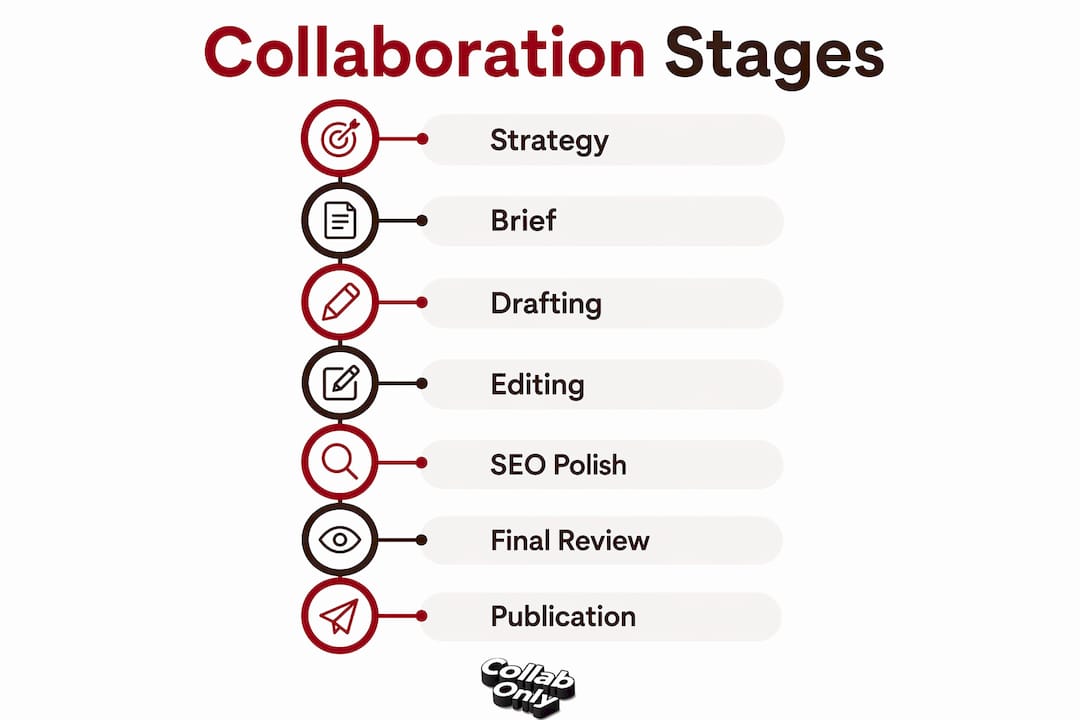
A standard content workflow runs through six to seven stages: strategy and ideation, brief and outline, drafting, editing and review, SEO polish, final approval, and publication with measurement. Each stage produces a specific deliverable, and the next stage does not begin until that deliverable is approved. This sequential structure is what separates a repeatable system from an ad hoc project.

| Stage | Owner | Output | Exit condition |
|---|---|---|---|
| Strategy and ideation | Content lead | Topic list, goals | Signed-off content calendar |
| Brief and outline | Content strategist | Approved brief | All stakeholders sign brief |
| Drafting | Content creator | First draft | Draft matches brief criteria |
| Editing and review | Editor | Revised draft | No structural changes needed |
| SEO polish | SEO specialist | Optimized draft | Keyword and metadata targets met |
| Final approval | Approver or brand lead | Approved file | Written sign-off received |
| Publication and measurement | Publisher or analyst | Live content, report | KPIs tracked at 7 and 30 days |
The brief stage carries outsized importance. Failure to approve a brief before drafting begins increases revision time by 2 to 3 times. That single checkpoint prevents the most common source of wasted effort in collaborative content projects.
Handoffs between stages must be explicit. A creator who finishes a draft should not simply email it to an editor. The draft moves through a defined channel, with the brief attached, so the editor has full context. Briefs must travel with drafts at every stage to maintain alignment and reduce confusion.
Pro Tip: Build a stage-exit checklist into your project management tool. No task moves forward until every item on that checklist is checked. This removes ambiguity and keeps the workflow self-enforcing.
Which tools, roles, and communication methods support effective content collaboration?
Effective stepwise content teamwork depends on five clearly defined roles. Each role has a specific lane and does not cross into another without a formal handoff.
- Content creator: Produces the first draft based on the approved brief. Responsible for tone, structure, and narrative.
- Subject matter expert (SME): Reviews for factual accuracy. Does not rewrite prose. Flags errors and provides corrections.
- Editor: Improves clarity, flow, and alignment with brand voice. Does not introduce new topics or change the core argument.
- SEO specialist: Applies keyword targets, meta descriptions, and internal linking. Works from the editor's approved draft.
- Approver: Gives final sign-off. Reviews for brand compliance and legal risk only. Does not re-edit.
Assigning a single owner per stage with clear handoff conditions reduces bottlenecks by 30–50%. The RACI model (Responsible, Accountable, Consulted, Informed) is the standard framework for documenting this. A lightweight RACI matrix with one owner per stage prevents committee gridlock and keeps production moving.
Tool categories that support this structure fall into four groups. Project management platforms track task status and deadlines. Communication platforms handle threaded discussions tied to specific tasks. Document collaboration tools allow inline comments and version control. Asset libraries store approved brand files, templates, and media.
Communication discipline matters as much as the tools themselves. Centralized feedback in one location prevents the scenario where a creator receives conflicting notes from three different channels simultaneously. Async review cycles with defined response windows keep projects moving without requiring everyone online at the same time. Scattered feedback drastically increases revision time and causes confusion that compounds across stages.
Pro Tip: Designate one feedback thread per piece of content. If a stakeholder sends notes via email or direct message, the project manager consolidates them into the central thread before the creator sees them. This single practice eliminates most revision-cycle chaos.
How can marketers and creators co-create content efficiently?
True content co-creation moves beyond licensing agreements into a lifecycle model that aligns brand goals with creator expertise. The distinction matters because licensed content treats creators as vendors. Co-creation treats them as production partners with audience insight the brand cannot replicate internally.
The lifecycle approach runs through four phases: discovery workshops, audience research, production sprints, and post-campaign analysis. Each phase has defined inputs and outputs, mirroring the workflow structure described above. This prevents the co-creation process from becoming an open-ended creative conversation with no deliverable.
A numbered process for smooth co-creation looks like this:
- Define decision rights upfront. Specify which creative decisions belong to the creator, which require brand approval, and which are non-negotiable brand standards. Document this before any content is produced.
- Run a discovery workshop. Bring the brand lead and creator together to align on audience, tone, and campaign goals. The output is a shared brief, not a mood board.
- Conduct audience research. The creator contributes platform-specific audience data. The brand contributes campaign performance benchmarks. Both inform the content angle.
- Execute production sprints. Break content production into short cycles with defined review points. A two-week sprint with one mid-point check-in outperforms a six-week open production window.
- Run post-campaign analysis. Measure against the KPIs set in the brief. Share results with the creator so both parties learn from the data.
Effective collaboration requires creators focusing on quality, SMEs on accuracy, and managers on brand alignment. When those lanes blur, the result is a "committee project" where everyone has input but no one has ownership. Committee projects produce diluted messaging and miss market timing. The creator partnership process works precisely because it enforces those boundaries from the start.
What are common challenges in content collaboration and how to prevent them?
Most content collaboration failures stem from unclear ownership, not lack of creativity. A project stalls not because no one has ideas, but because no one knows who has the authority to approve the next step. Identifying that gap is the first diagnostic move when a project loses momentum.
The most damaging pattern is the side approval. A stakeholder outside the defined workflow reviews a draft and sends notes directly to the creator. Those notes conflict with the editor's feedback. The creator now has two sets of instructions and no way to reconcile them. Multiple conflicting feedback sources delay projects by several business days and cause teams to miss market timing windows.
Best practices for maintaining workflow health:
- Time-box every review stage. Set a maximum review window, such as two business days for internal editors and three business days for client approvals. Reviews without deadlines expand indefinitely.
- Document all decisions in one place. When a creative direction changes, record the decision in the project thread, not in a side conversation. This creates an audit trail and prevents the same debate from recurring.
- Limit revision rounds. Define a maximum number of revision cycles per stage, typically two. A third revision signals a problem with the brief, not the draft.
- Enforce single-path approvals. One designated approver per stage. All other stakeholders are consulted before the draft reaches that approver, not after.
- Keep the brief visible. Attach the approved brief to every review request. Reviewers who lose sight of the original brief tend to introduce scope creep.
Pro Tip: When a project enters its third revision cycle, pause production and return to the brief. Nine times out of ten, the brief was ambiguous on a key point. Fix the brief first, then resume drafting.
For a practical reference on managing collaboration challenges, structured checklists and role-based review protocols are the most reliable tools available.
Samuel's take on what actually separates good collaboration from great
The conversation about content collaboration in 2026 centers heavily on AI adoption. Only 71.1% of marketers perform mandatory human review despite 91% AI adoption across content teams. That gap is where quality erodes. The recommended split is 70% AI handling drafting and research, with 30% human oversight focused on strategic voice, unique insights, and factual verification. AI tools that cut research time significantly are genuinely useful, but they do not replace the judgment call that a skilled editor makes when a draft is technically accurate but strategically wrong.
What I have observed consistently is that teams over-invest in tool selection and under-invest in role clarity. The tool does not matter if the RACI is broken. Psychological safety within the team matters more than most managers admit. When contributors fear that their input will be overridden arbitrarily, they stop contributing early in the process, which is exactly when broad input is most valuable. The principle of broad input early and narrow approvals late is not just a workflow rule. It is a cultural signal that the team's expertise is respected.
Iterative improvement is the final piece. Run a 15-minute retrospective after every content sprint. Ask three questions: what slowed us down, what worked, and what one change would we make next sprint. Teams that do this consistently outperform those that treat the workflow as fixed. The workflow is a living document, not a policy manual.
— Samuel
Collabonly's influencer marketplace for structured creator partnerships
Finding the right creator is the first operational step in any collaboration workflow. Collabonly's influencer marketplace connects brands with creators across TikTok, Instagram, and YouTube through a match-based system that replaces slow email outreach with instant chat upon connection.

The platform supports the full collaboration lifecycle described in this guide. Brands define campaign goals, match with aligned creators, and move directly into production without the friction of cold outreach. For marketers building a repeatable content partnership process, Collabonly provides the partner discovery layer that most workflow tools do not address. The result is a shorter path from brief to live content, with creator alignment built in from the first interaction.
Key takeaways
Structured content collaboration workflows with defined ownership at every stage are the single most reliable method for increasing output quality and reducing revision cycles.
| Point | Details |
|---|---|
| Workflow stages drive output | A 6 to 7 stage workflow with clear exit conditions increases monthly content volume significantly. |
| Brief approval is non-negotiable | Skipping brief sign-off before drafting increases revision time by 2 to 3 times. |
| Single owner per stage | A RACI model with one owner per stage reduces bottlenecks by 30–50%. |
| Co-creation requires lifecycle structure | Discovery, research, production sprints, and post-campaign analysis align brand and creator goals. |
| Side approvals cause the most delays | Enforcing single-path approvals and time-boxed reviews prevents the majority of stalled projects. |
FAQ
What is step by step content collaboration?
Step by step content collaboration is a workflow-driven process where each content stage, from ideation to publication, has a defined owner, output, and approval condition. It is the operational equivalent of a production pipeline applied to content creation.
How many stages does a content collaboration workflow typically include?
A standard content collaboration workflow includes 6 to 7 stages: strategy, brief, drafting, editing, SEO polish, final approval, and publication with measurement.
Why do content collaboration projects stall?
Most stalled projects result from unclear ownership, not creative problems. Conflicting feedback from multiple reviewers and missing brief sign-offs are the two most common causes of delay.
What is the recommended AI-to-human ratio in content workflows?
Experts recommend a 70/30 split: AI handles approximately 70% of drafting and research tasks, while human reviewers focus on strategic voice, accuracy, and brand alignment.
How do brands and creators co-create content effectively?
Effective co-creation follows a lifecycle model covering discovery workshops, audience research, production sprints, and post-campaign analysis, with decision rights defined before any content is produced.