

Collaborative growth is a deliberate, partnership-led strategy that drives scalable revenue and market access by aligning businesses, creators, and ecosystems around shared commercial goals. As defined in ecosystem strategy literature, it extends beyond ecosystem management by adding lead generation and sales enablement to partner-focused operations, making revenue teams direct beneficiaries of every partnership. The practical result: organizations that build structured collaborative-growth programs gain access to new customer segments, co-developed products, and distribution channels they could not reach independently.
Common outcomes leaders can expect from a well-run collaborative-growth program:
- New customer acquisition through partner-referred or co-marketed pipelines
- Co-innovation that compresses product development timelines
- Faster market access via established partner distribution networks
- Credibility transfer from high-trust partners to the brand's own audience
Key Takeaways
Collaborative growth produces compounding returns when it is structured, measured, and governed with the same rigor applied to any other revenue channel.
| Point | Details |
|---|---|
| Definition and scope | Collaborative growth adds lead generation and sales enablement to ecosystem management, making revenue teams direct beneficiaries of every partnership. |
| Theoretical grounding | Resource-Based View, Network Theory, and Open Innovation each explain why pooled capabilities and relational capital outperform solo growth strategies. |
| Five-pillar framework | Strategy and intent, matching and discovery, enablement and activation, governance and incentives, and measurement and attribution form the repeatable execution model. |
| Measurement imperative | Establish partner-influenced revenue, partner-sourced pipeline, and partner-assisted CAC as primary KPIs before the program launches, not after. |
| 90-day pilot recommendation | Select two to three high-fit partners, run a narrow referral or co-marketing pilot, and review KPIs at day 60 to determine which model to scale. |
Table of Contents
- What does collaborative growth actually mean in practice?
- Why collaborative growth works: the theoretical foundation
- Five pillars leaders can use to design a collaborative-growth program
- How to apply collaborative growth: a 90-day playbook
- What skills and team structure does collaborative growth require?
- Examples of collaborative growth across industries and formats
- What does the evidence say about platforms and structured collaboration?
- How to measure collaborative growth: KPIs and attribution
- Best practices that improve collaborative-growth outcomes
- An editorial perspective on when collaborative growth is the right choice
- Sources
- FAQ
What does collaborative growth actually mean in practice?
Collaborative growth is not informal teamwork, and it is not the same as ecosystem management. The distinction matters operationally. Ecosystem management focuses on maintaining a network of partners; collaborative growth adds a revenue mandate, requiring that every partnership contribute measurably to pipeline, customer acquisition, or product expansion. Strategic collaborations expand customer reach and credibility while providing cost-efficient access to new markets and faster customer acquisition, which is a different performance bar than simply maintaining partner relationships.
Inside organizations, ownership of collaborative growth typically sits across several functions simultaneously. Partnership leads own the relationship and deal structure. Revenue operations own attribution and pipeline reporting. Marketing owns co-branded activation. Product or engineering owns integration-level partnerships. This cross-functional ownership is a feature, not a defect; it forces alignment that purely siloed programs cannot achieve.
Common models and formats include:
- Co-marketing campaigns (joint content, shared media spend, co-branded events)
- Revenue partnerships (referral agreements, channel reseller programs, affiliate structures)
- Creator-brand collaborations (sponsored content, product co-creation, ambassador programs)
- Joint productization (API integrations, bundled offers, white-label arrangements)
- SME consortium arrangements (shared export infrastructure, collective procurement)
Pro Tip: Treat collaboration as a strategic program, not a tactical campaign, when the partnership involves shared revenue targets, a defined governance structure, or a multi-quarter commitment. A one-off co-marketing post is a campaign. A quarterly co-selling motion with shared KPIs is a program. The distinction determines how you staff, budget, and measure it.
Why collaborative growth works: the theoretical foundation
Three established management frameworks explain why collaboration produces superior growth outcomes compared to purely organic or acquisition-led strategies.
The Resource-Based View (RBV) holds that competitive advantage comes from controlling rare, valuable, and difficult-to-imitate resources. Collaborative growth operationalizes RBV by allowing organizations to pool complementary capabilities: one partner's distribution reach combined with another's product depth creates a competitive position neither could build alone in the same timeframe. The mechanism is additive rather than substitutive.
Network Theory adds a relational dimension. Organizations embedded in dense, high-quality networks gain preferential access to market intelligence, referral flows, and co-innovation opportunities. Networking and relational capital amplify market access in ways that transactional relationships cannot replicate. Network position, not just network size, determines how much value a partner relationship generates.
Open Innovation, the third framework, argues that organizations that deliberately source ideas, talent, and technology from outside their boundaries innovate faster and at lower cost than those that rely solely on internal R&D. Collaborative growth applies this logic commercially: co-innovation sprints, joint product development, and creator-driven content all draw on external capability to accelerate output.
A mixed-methods study of SMEs across five economies found strong positive associations between collaboration frequency and performance outcomes including revenue growth and innovation. The authors identify resource sharing, co-innovation, and digital networking as the primary mechanisms, and cite Resource-Based View and Network Theory as the explanatory frameworks.
Five pillars leaders can use to design a collaborative-growth program
The framework below organizes collaborative-growth execution into five repeatable pillars. Each pillar has a clear owner, a set of practical activities, and measurable outputs.
| Pillar | Owner | Key Activities | Example Deliverables | Primary Metrics |
|---|---|---|---|---|
| Strategy and intent | Partnership lead | Define goals, select partner tiers, set revenue targets | Partner ICP, tier criteria, 90-day roadmap | Pipeline target, partner count |
| Matching and discovery | Partnerships + Marketing | Identify, vet, and recruit partners | Partner shortlist, outreach templates | Time-to-first-match, acceptance rate |
| Enablement and activation | Enablement + Creative | Build co-marketing assets, train partners | Co-branded decks, referral kits, playbooks | Asset utilization, partner activation rate |
| Governance and incentives | Revenue ops + Legal | Set SLAs, commission structures, escalation paths | Partner agreement, scorecard, incentive model | SLA adherence, partner satisfaction score |
| Measurement and attribution | Revenue ops + Analytics | Track partner-influenced revenue, report on KPIs | Attribution dashboard, monthly partner report | Partner-sourced revenue, CAC via partners |
Practical activities by pillar:
- Strategy and intent: document the business case, define partner personas, and set a minimum viable partnership (MVP) threshold before recruiting begins.
- Matching and discovery: use structured outreach sequences and marketplace platforms to reduce time-to-match; prioritize partners with complementary audiences, not just overlapping ones.
- Enablement and activation: produce a partner starter kit (one-pager, referral link, co-branded template) within the first two weeks of a new partnership going live.
- Governance and incentives: establish a shared scorecard reviewed monthly; misaligned incentives are the most common reason high-potential partnerships stall.
- Measurement and attribution: implement multi-touch attribution from day one; retrofitting attribution logic after launch is expensive and produces contested data.
How to apply collaborative growth: a 90-day playbook
A structured launch sequence reduces the risk of wasted effort and creates early proof points that justify further investment.
The start-up sequence
- Define goals and success criteria. Specify the revenue, pipeline, or customer-acquisition target the program must hit within 90 days. Vague goals produce vague results.
- Map potential partners. Build a partner ICP (ideal partner profile) based on audience complementarity, distribution reach, and strategic alignment. Aim for 10–15 candidates in the first cohort.
- Design the pilot. Select two or three partners for a narrow, time-boxed pilot: a co-marketing campaign, a referral program, or a creator-driven product bundle. Narrow scope accelerates learning.
- Formalize agreements. Draft a lightweight partnership agreement covering revenue-sharing terms, content approval rights, attribution methodology, and exit conditions. Legal review is non-negotiable before any revenue-sharing arrangement goes live.
- Launch with a defined cadence. Set a weekly check-in rhythm with each partner for the first 30 days, then move to bi-weekly once the program is stable.
- Review and scale. At day 60, assess pilot KPIs against success criteria. Scale what works; terminate or restructure what does not.
90-day pilot checklist
- Roles assigned: partnership lead, revenue ops contact, legal reviewer, creative/enablement owner
- Partner ICP documented and approved
- Two to three pilot partners selected and agreements signed
- Co-marketing or referral assets produced and distributed
- Attribution methodology configured in CRM (HubSpot, Salesforce, or equivalent)
- KPI dashboard live and shared with stakeholders
- Weekly partner check-in cadence scheduled
- 60-day review meeting booked at program launch
For a step-by-step campaign execution framework, content collaboration guides provide sequential templates that reduce setup time for new programs.
Pro Tip: The fastest early validation comes from a referral pilot or a co-marketing activation with a single high-fit partner. Measure partner-influenced revenue at day 30. If the signal is positive, replicate the model with two additional partners before investing in infrastructure. Pilots that try to prove too many variables simultaneously produce inconclusive data.
What skills and team structure does collaborative growth require?
Collaborative growth fails most often not because the strategy is wrong, but because the team executing it lacks the right mix of skills or the governance to stay coordinated across functions.
Core roles
- Partnership lead: owns the partner relationship, deal structure, and recruitment pipeline
- Revenue operations: owns attribution, pipeline reporting, and CRM configuration
- Product or engineering liaison: required for integration-level partnerships and joint productization
- Legal and finance: reviews agreements, manages commission structures, and handles compliance
- Enablement and creative: produces partner assets, co-branded content, and training materials
- Program manager: coordinates cross-functional workstreams and maintains the governance calendar
Key skills
- Systems thinking: the ability to model how a partner action (a referral, a co-created post) propagates through the revenue funnel
- Negotiation: structuring deals where both parties perceive equitable upside, not just the initiating brand
- Partner marketing: designing activation programs that motivate partners to promote actively, not passively
- Attribution literacy: understanding multi-touch models, referral-code tracking, and revenue-sharing reconciliation
- Platform literacy: working fluency with CRM systems, marketplace platforms, and collaboration tools
Governance structure
Effective collaboration requires formal structures, including team charters, shared principles, and explicit accountability, to avoid energy drain and deliver consistent results. For collaborative-growth programs, this translates to three governance artifacts:
- A team charter that defines each role's decision rights and escalation path
- A partner scorecard reviewed monthly, covering pipeline contribution, activation rate, and satisfaction
- An operating rhythm: weekly internal syncs, bi-weekly partner check-ins, and a quarterly business review with strategic partners
A JD Supra analysis of structured collaboration distinguishes between structured, strategic, and spontaneous collaboration as distinct operational modes. Collaborative-growth programs require the first two: structured for repeatable execution, strategic for high-stakes partner decisions. Spontaneous collaboration, while valuable for culture, does not produce consistent revenue outcomes without a governance layer.
Pro Tip: Convert informal collaborators into accountable program participants by assigning each one a named deliverable and a reporting line. A creator who has agreed to "work together sometime" becomes a program participant the moment they sign a lightweight brief with a deadline, a deliverable, and a defined success metric. Formalization does not kill creative energy; it channels it.
For templates and playbook structures that support this transition, collaboration streamlining guides for leaders provide ready-to-adapt frameworks.
Examples of collaborative growth across industries and formats
Collaborative growth applies across business types and scales. The use cases below span B2B, B2C, creator-economy, and SME contexts.
Common formats and applications:
- Co-marketing campaigns: two brands share media spend and content production to reach each other's audiences simultaneously
- Product integrations: a SaaS company embeds a partner's functionality, creating a bundled value proposition neither could offer independently
- Creator-driven launch bundles: a brand partners with a creator to produce exclusive content tied to a product launch, distributing through the creator's audience on TikTok, Instagram, or YouTube
- Channel partner revenue shares: a vendor recruits resellers or referral partners who earn commission on closed deals
- SME consortium exports: small businesses pool logistics, compliance, and marketing resources to enter export markets collectively
- Joint innovation sprints: two organizations co-develop a product feature or service offering over a defined sprint period
- Affiliate and referral programs: structured commission arrangements that incentivize partners to drive qualified traffic or leads
- Giveaway and community activation: brands co-sponsor audience engagement events to grow shared community reach
Strategic partnerships combine complementary strengths to expand market reach, reduce risk, and accelerate innovation. Common formats include technology integrations, co-marketing arrangements, and distribution alliances, each producing measurable business outcomes when structured with clear incentives and attribution.
Three compact examples illustrate how these formats perform in practice:
A mid-market B2B software company partnered with a complementary analytics vendor to offer a bundled integration. The integration was co-marketed to both companies' existing customer bases. Within one quarter, the partnership generated a measurable increase in trial sign-ups for both products, with the analytics vendor attributing a material share of new logo acquisition to the co-marketing activation.

A direct-to-consumer apparel brand collaborated with three micro-creators on a limited-edition product drop, giving each creator an exclusive referral code and early access to the product. The creators produced organic content across Instagram and TikTok. The campaign produced a higher conversion rate than the brand's standard paid media, with lower cost per acquisition, because the creators' audiences trusted the recommendation as peer-credible rather than promotional.
An SME consortium in the food and beverage sector pooled export compliance resources and shared a single logistics partner to enter two new regional markets simultaneously. Individual members lacked the capital to enter those markets independently; the consortium structure distributed fixed costs and shared market intelligence, reducing time-to-first-sale for each member.
For a curated set of partnership campaign formats and outcomes, Collabonly's resource library documents additional examples with setup details.
Platform-based matching reduces the friction inherent in all of these formats. Discovery, outreach, and initial communication typically consume the most time in partnership development. Marketplace platforms that use structured matching and instant communication on confirmed connections compress that timeline materially, allowing teams to move from partner identification to active collaboration faster.
What does the evidence say about platforms and structured collaboration?
The research base for collaborative growth draws from both academic and practitioner sources, and the findings point consistently in the same direction: structure and platform support are the two variables that most reliably convert partnership intent into revenue outcomes.
A mixed-methods study of SMEs across five economies found strong positive associations between collaboration frequency and performance outcomes. The authors report that resource sharing, co-innovation, and digital networking are the primary mechanisms linking collaboration to revenue growth and innovation. Network position, not just network size, amplifies access to new markets.
The Center for Creative Leadership's guidance on leading collaborative teams reinforces this: without formal structures, team charters, and explicit accountability, collaborative efforts drain energy rather than generate returns. The implication for partnership programs is direct: informal collaboration produces inconsistent results; structured programs with defined governance produce repeatable ones.
Platform capabilities that materially enable execution:
- Discovery and matching: structured filtering by audience, category, platform, and goal reduces partner-search time from weeks to days
- Instant communication on confirmed matches: eliminates the cold-outreach bottleneck that causes most partnership conversations to stall before they begin
- Attribution and tracking: referral codes, UTM parameters, and revenue-sharing dashboards make partner contribution visible and auditable
- Partner enablement: centralized asset libraries and brief templates reduce the time partners spend asking for materials
- Analytics and reporting: real-time dashboards allow program managers to identify underperforming partnerships before they consume further resources
Collabonly addresses the discovery and communication bottleneck directly: its swipe-based matching interface and instant chat on confirmed connections are designed to convert matches into goal-aligned partnerships across TikTok, Instagram, YouTube, and other platforms, without the delays of cold email or lost DMs. For teams running creator-brand collaborations, influencer campaigns, or B2B vendor discovery, platform-based collaboration reduces the operational overhead of partner recruitment significantly.
Pro Tip: When selecting a collaboration platform, require these four capabilities before committing: structured partner discovery with audience and goal filters; instant communication on confirmed matches (not just a messaging inbox); attribution or referral-tracking built into the platform; and a partner profile system that captures goals, not just demographics. Red flags include platforms that require manual outreach after matching, lack any attribution layer, or cannot filter partners by commercial intent.
How to measure collaborative growth: KPIs and attribution
Measurement is where most collaborative-growth programs lose credibility with finance and executive stakeholders. The solution is a defined KPI architecture established before the program launches, not retrofitted after the first quarter.
Primary KPIs:
- Partner-influenced revenue: total revenue from deals where a partner played a role at any stage of the funnel
- Partner-sourced pipeline: new opportunities created directly through partner referrals or co-marketing
- Partner-assisted customer acquisition cost (CAC): the cost to acquire a customer through a partner channel versus direct channels
- Churn rate for partner-acquired customers: a leading indicator of partner-fit quality; high churn signals misaligned partner audiences
- Time-to-value for joint offers: how quickly a co-developed product or bundled offer generates its first revenue
Secondary KPIs:
- Co-created content engagement rate (views, shares, saves, click-throughs)
- Lead quality scores for partner-referred leads versus direct leads
- Partner activation rate: the percentage of signed partners who generate at least one qualified referral or co-marketing output within 60 days
- Partner Net Promoter Score (NPS): a measure of partner satisfaction and likelihood to continue the relationship
| KPI | Data Source | Typical Tool | Reporting Cadence |
|---|---|---|---|
| Partner-influenced revenue | CRM opportunity records | Salesforce, HubSpot | Monthly |
| Partner-sourced pipeline | CRM lead source tagging | Salesforce, HubSpot | Weekly |
| Partner-assisted CAC | Finance + CRM combined | Custom dashboard | Quarterly |
| Churn rate (partner-acquired) | Customer success platform | Gainsight, ChurnZero | Quarterly |
| Co-content engagement rate | Platform analytics | Native analytics, Sprout Social | Weekly |
| Partner activation rate | Program tracker | Spreadsheet or PRM | Monthly |
Attribution approaches worth implementing from day one:
- Multi-touch partner attribution: assign credit to partner touchpoints across the full funnel, not just the last touch before close
- Referral codes: unique codes per partner allow revenue-sharing reconciliation without CRM dependency
- Lead enrichment: append partner-source data to every inbound lead at the point of capture, not retroactively
- Revenue-sharing reconciliation: establish a monthly reconciliation cadence with finance to validate partner commission calculations against CRM data
Forbes analysis of strategic collaboration outcomes identifies expanded customer reach, credibility transfer, and faster customer acquisition as the primary measurable benefits of structured partnerships, each of which maps directly to the KPIs above.
Best practices that improve collaborative-growth outcomes
The behaviors below separate programs that compound over time from those that plateau after the first pilot.
- Align on goals before activating: document shared success criteria with each partner before any co-marketing or referral activity begins. Misaligned expectations are the primary cause of partnership dissolution.
- Build shared incentives, not one-sided ones: commission structures, content credits, and co-marketing budgets should create genuine upside for both parties. A partner who earns nothing from the arrangement will deprioritize it.
- Establish fast feedback loops: review partner performance data weekly in the first 60 days. Early signals of underperformance are correctable; late-stage discovery of a failing partnership wastes resources and damages the relationship.
- Use lightweight SLAs: a one-page service-level agreement covering response times, content approval windows, and revenue-sharing payment schedules prevents the ambiguity that erodes trust over time.
- Optimize partner discovery continuously: revisit the partner ICP quarterly. Markets shift, and the partner profile that was ideal at program launch may not reflect the best opportunity six months later.
- Standardize onboarding: a partner starter kit (brief, referral link, co-branded assets, FAQ document) reduces the time between agreement signing and first activation from weeks to days.
- Co-creation cadence: schedule a monthly creative session with active partners to develop new content formats, campaign ideas, or product bundling concepts. Partnerships that only communicate about performance data stagnate.
For additional brand collaboration formats and co-creation tips, Collabonly's resource library documents proven structures across creator-brand and B2B contexts.
Pro Tip: Run A/B experiments within your partner cohort before scaling. Activate two partners with similar profiles using different incentive structures or co-marketing formats, then measure which produces higher partner-sourced pipeline at 30 days. Scale the winning model to the next cohort. This approach prevents over-investment in formats that look good in theory but underperform in practice.
An editorial perspective on when collaborative growth is the right choice
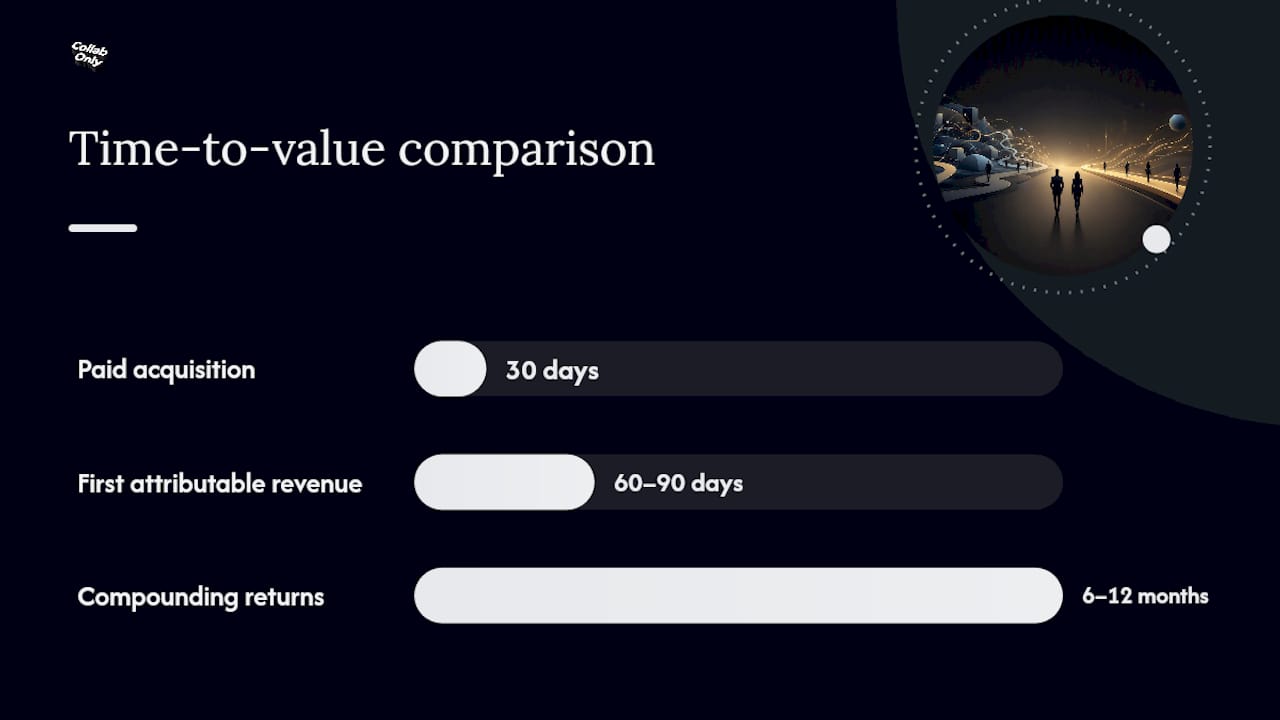
Collaborative growth is not the right primary growth channel for every organization at every stage. The time-to-value profile is longer than paid acquisition: a well-structured program typically requires 60–90 days to produce its first attributable revenue, and 6–12 months to demonstrate compounding returns. Leaders who need revenue in the next 30 days should not redirect budget from paid channels to partnership programs mid-quarter.
When to prioritize collaborative growth:
- The organization has reached the limits of its own distribution and needs access to new audiences it cannot reach cost-efficiently through paid media
- The product or service benefits from peer-credibility transfer, meaning customers trust a recommendation from a known partner more than a direct brand claim
- The business model supports revenue sharing, referral commissions, or co-marketing investment without requiring immediate payback
When to deprioritize it:
- Internal incentive structures do not reward partnership-sourced revenue equally with direct-sourced revenue; this misalignment will cause the program to be deprioritized by sales teams regardless of its strategic merit
- The organization lacks the governance capacity to manage partner relationships; an under-resourced program damages partner relationships and produces worse outcomes than no program at all
- The product is not yet stable enough to co-market; exposing a partner's audience to a product with unresolved quality issues transfers reputational risk to the partner and terminates the relationship
The most common mistake leaders make is treating collaborative growth as a cost-free channel. It requires real investment in enablement, governance, and attribution infrastructure. The return is real, but so is the cost. Measuring partner outcomes as a governance requirement, not an afterthought, is what separates programs that earn continued investment from those that are quietly defunded after two quarters.
Sources
- How to lead a collaborative team | Center for Creative Leadership
- SME collaboration and mutual opportunity creation (SCIRP)
- 5 Reasons Strategic Collaborations Are Guaranteed To Help You Grow Your Business | Forbes
- What is Collaborative Growth? - Medium
FAQ
What does collaborative growth mean in business?
Collaborative growth is a partnership-led revenue strategy in which organizations align with external partners, creators, or ecosystems to achieve shared commercial goals, including new customer acquisition, co-innovation, and market expansion, that neither party could reach as efficiently alone.
What are the three C's of collaboration?
Definitions of the "three C's" vary by source and framework. A widely used version in partnership and team contexts covers communication, coordination, and commitment: clear communication aligns expectations, coordination structures joint execution, and commitment ensures both parties invest proportionally in the program's success.
What are some examples of collaboration goals in a growth program?
Common collaboration goals include generating a defined volume of partner-referred pipeline within 90 days, co-producing content that reaches a combined audience of a specified size, reducing customer acquisition cost through partner channels versus direct paid media, and launching a jointly developed product feature or bundled offer within a set timeframe.
What are the four types of collaboration in a business context?
Four commonly recognized types are: strategic collaboration (high-stakes, long-term partnerships aligned to core business objectives); co-marketing collaboration (joint campaigns sharing media spend and audience reach); product or integration collaboration (technical partnerships that create bundled or interoperable offerings); and creator or influencer collaboration (brand-creator partnerships that leverage audience trust and peer-credibility for distribution and conversion).